
What is GLM-5.3-Flash, was it Ox Alpha and are the weights available?
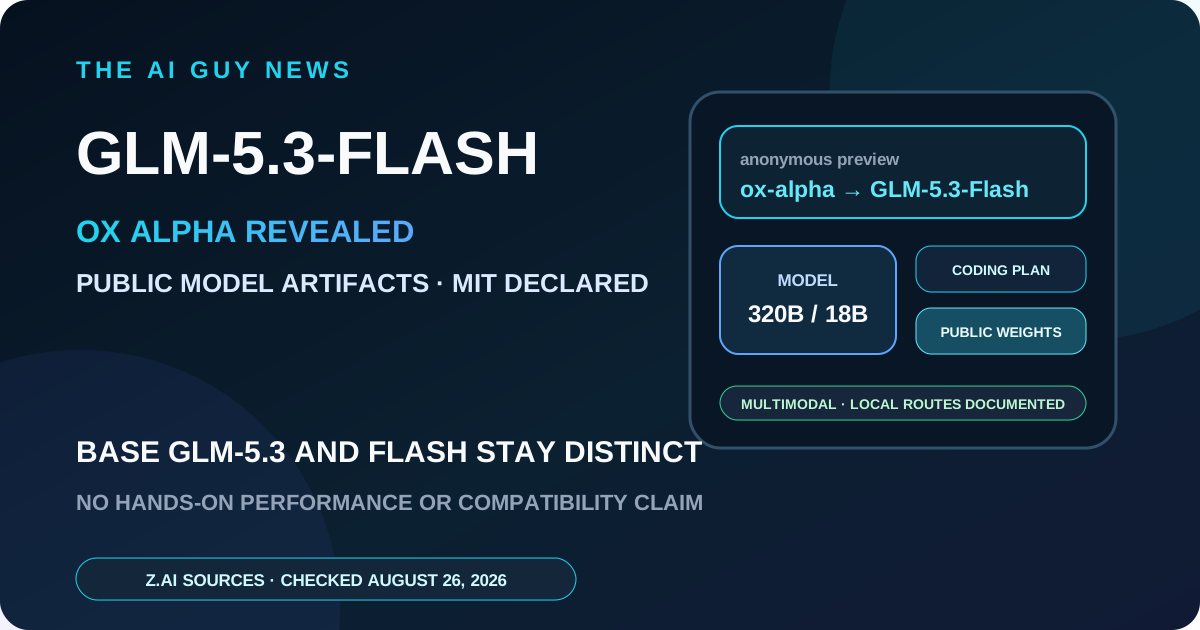
Z.ai has identified the anonymous Ox Alpha preview on OpenCode and OpenRouter as GLM-5.3-Flash. The company says the natively multimodal model is available to all GLM Coding Plan users, while a public Hugging Face repository now provides MIT-licensed model artifacts and documented local-serving paths. The existing GLM-5.3 API remains a separate text-only model with its own routes and prices.
Ox Alpha was GLM-5.3-Flash
Z.ai says it tested GLM-5.3-Flash anonymously as ox-alpha on OpenCode and OpenRouter before the formal release. The company describes Flash as the first natively multimodal model in the GLM-5 series, with 320 billion total parameters and 18 billion active parameters. Those specifications and the identity disclosure are vendor statements; The AI Guy has not tested the preview or release.
Weights and Coding Plan access are live
Z.ai says GLM-5.3-Flash has rolled out to all GLM Coding Plan users and provides three times the usable plan quota of GLM-5.3. The company also exposes Flash in ZCode for Browser Use and Computer Use. Separately, Z.ai's public, ungated Hugging Face repository provides the model artifacts and declares an MIT license. The AI Guy has not tested the quota, ZCode behavior, model artifacts or license use.
Availability matrix: base model, Flash access and public weights
GLM-5.3 base model — text-only, with Coding Plan and API routes live and the posted base-model prices below. GLM-5.3-Flash in Coding Plan and ZCode — Z.ai says it is live for all Coding Plan users and supports multimodal Browser Use and Computer Use in ZCode. GLM-5.3-Flash weights — public and ungated on Hugging Face with an MIT declaration and documented local-serving paths for SGLang, vLLM, TokenSpeed and KTransformers. These are documented routes, not verified compatibility or performance.
What developers can use now
GLM-5.3 is available through the GLM Coding Plan, and Z.ai says it works with coding-agent clients including ZCode, Claude Code and OpenCode. The vendor describes it as an update to the same base model used for GLM-5.2, with the gains coming from post-training. TechNode independently confirmed the model launch and same-base description on August 17.
Reasoning is required
GLM-5.3 is text-only, with a 1M-token context window and a maximum output length of 128K tokens. Reasoning is always enabled: developers can select low, high or max effort but cannot turn it off. Z.ai warns that an application sending thinking.type as disabled must change that setting before switching to the glm-5.3 model ID or the request will fail.
Off-peak calls use fewer quota points
The GLM Coding Plan has moved to points-based quotas. Z.ai says calls outside 14:00-18:00 UTC+8 from Monday to Friday consume 50% of standard points, and weekends receive the same off-peak treatment. That is a quota-accounting change, not evidence that the subscription price or a standalone token price has been cut in half.
The GLM-5.3 API is live
Z.ai announced the API as live on August 18. Its documentation now lists OpenAI Chat Completion, OpenAI Response and Anthropic Message routes and uses the glm-5.3 model ID in request examples. Z.ai's posted pay-as-you-go prices for the base GLM-5.3 model, checked August 19, are $1.40 per million input tokens, $0.26 per million cached-input tokens and $4.40 per million output tokens; cached-input storage is listed as free for a limited time. These are base-model API token prices, not GLM-5.3-Flash prices or Coding Plan point quotas. VentureBeat independently confirmed the base-model launch and prices on August 19.
Check the protocol before migrating
Z.ai's migration guide tells developers to switch the model ID to glm-5.3, keep reasoning enabled, choose low, high or max effort and account for the 1M context and 128K output limits. Developers should also verify their endpoint, protocol and account access before changing production traffic. Z.ai says people who previously subscribed to a GLM Coding Plan, including expired subscribers, can currently access the model API only through the OpenAI Chat Completion-compatible protocol. The AI Guy has not tested application compatibility or endpoint reliability.
GLM-5.3-Flash weights are public; base and Flash remain distinct
The August 19 version of this page said GLM-5.3 weights were still pending. Z.ai has now released public artifacts for the new GLM-5.3-Flash model and its repository declares an MIT license. That does not make the two model IDs interchangeable: the base GLM-5.3 API covered above remains text-only, while Flash is a newly trained multimodal model with separate access and deployment documentation. Public artifacts and a declared license do not guarantee compatibility, performance or fitness for a particular use.
The bottom line
GLM-5.3-Flash closes the earlier weights-pending gap with public artifacts whose repository declares an MIT license, and adds a vendor-described multimodal option for Coding Plan and ZCode workflows. Keep it separate from the base GLM-5.3 API and its posted token prices. Verify the exact model ID, endpoint, quota and serving setup before changing a workflow; The AI Guy has not tested them.
Related tools and pages
Official sources
- Z.ai official GLM-5.3-Flash release ↗Checked 2026-08-26
- Z.ai official GLM-5.3-Flash model repository ↗Checked 2026-08-26
- Z.ai official GLM-5.3-Flash documentation ↗Checked 2026-08-26
- Bloomberg independent Ox Alpha report ↗Checked 2026-08-26
- Z.ai official GLM-5.3 launch ↗Checked 2026-08-19
- Z.ai official GLM-5.3 documentation ↗Checked 2026-08-19
- Z.ai official GLM-5.3 API pricing ↗Checked 2026-08-19
- Z.ai official GLM-5.3 migration guide ↗Checked 2026-08-19
- TechNode independent launch report ↗Checked 2026-08-19
- VentureBeat independent GLM-5.3 API report ↗Checked 2026-08-19
This is researched analysis based on public product information. The AI Guy has not independently benchmarked the feature described here.
FAQ
What was Ox Alpha?
Z.ai says Ox Alpha was the anonymous pre-release test of GLM-5.3-Flash on OpenCode and OpenRouter. The AI Guy did not test the preview.
Who can use GLM-5.3 now?
Z.ai says GLM-5.3 is available to all GLM Coding Plan users and that its model API is live. Previous Coding Plan subscribers, including expired subscribers, are currently limited to the OpenAI Chat Completion-compatible protocol.
Is the GLM-5.3 API generally available?
Z.ai announced the GLM-5.3 API as live on August 18 and documents OpenAI- and Anthropic-compatible routes. Previous Coding Plan subscribers, including expired subscribers, are currently limited to the OpenAI Chat Completion-compatible protocol.
How much does the base GLM-5.3 API cost?
Z.ai's posted base-model pay-as-you-go prices, checked August 19, 2026, are $1.40 per million input tokens, $0.26 per million cached-input tokens and $4.40 per million output tokens. Cached-input storage is listed as free for a limited time. These are not verified GLM-5.3-Flash prices.
Are GLM-5.3-Flash weights available?
Yes. Z.ai's public, ungated Hugging Face repository provides the GLM-5.3-Flash artifacts and declares an MIT license. The AI Guy has not tested local deployment, compatibility or license use.
Did The AI Guy test GLM-5.3?
No. This is a researched vendor-update brief based on Z.ai's official GLM-5.3 and GLM-5.3-Flash releases, model repositories, migration and pricing documentation plus independent reporting. The AI Guy has not tested either model, its APIs, quotas, weights, multimodal behavior, serving paths or compatibility.
More News & Guides

Google AI Mode Changes SEO: How AI Tool Sites Can Still Get Cited
AI searchGoogle's AI answers reduce traditional clicks, but they also create a new opportunity: become the source the answer engine cites.
Read guide →
How to Build an LLM Council for Better AI Decisions
AI workflowA practical framework for comparing answers from multiple AI perspectives before making a high-stakes business, product, or strategy decision.
Read guide →
Best AI Presentation Maker Questions to Ask Before Choosing a Tool
AI presentationsBefore choosing Gamma, Canva, Tome, Beautiful.ai, or another AI presentation tool, ask these practical selection questions first.
Read guide →