
What is Spotify's AI Persona badge and how will it affect recommendations?
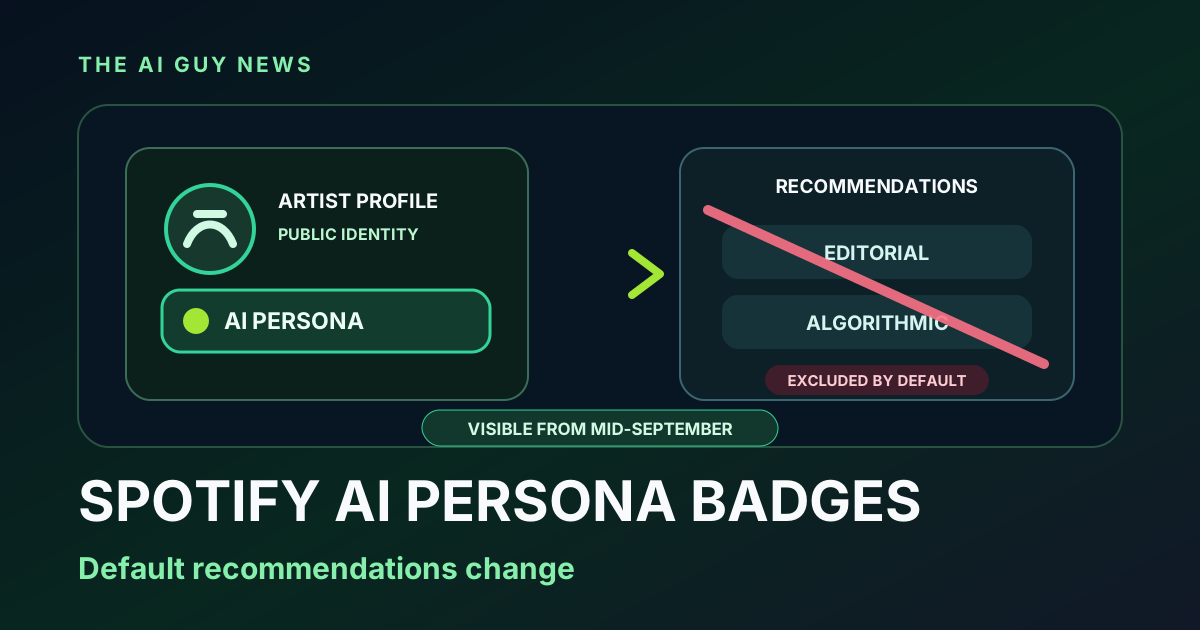
Spotify announced AI Persona badges for some artist profiles whose public identity may be AI-generated and does not represent a real person. Artist self-disclosure opened on August 11, visible badges are due to begin appearing in mid-September, and Spotify says AI Personas will stay out of editorial and algorithmic recommendations by default.
What Spotify is changing
Artists can now disclose through Spotify for Artists that their profile represents an AI Persona. Spotify says it will not rely on self-disclosure alone. The company also plans to review profiles whose names and imagery appear to present photorealistic AI-generated identities, starting with profiles that meet defined audience thresholds. TechCrunch independently confirmed the announcement and core rollout details on August 11.
Where the badge will appear
Spotify says users will begin seeing the badge on some artist profiles in mid-September. It plans to show the label in profile banners and About sections, in Search and on track rows inside playlists. If Spotify applies a badge after review, the artist will be notified and can self-disclose or appeal. A listener-reporting route is planned for the coming months; Spotify did not say it is available now.
Recommendation treatment is the bigger workflow change
Spotify says AI Personas will not be included by default in editorial or algorithmic recommendations. The company gives following an AI Persona as an example of an explicit user signal that can allow its music to appear in personalized recommendations. For creators, that means profile identity may affect discovery even when a release remains available on Spotify. The announcement does not say labeled profiles will be removed, that every listener will stop encountering them or that every use of AI in music triggers the badge.
The badge is about identity, not production
Spotify distinguishes between the identity presented by an artist profile and how a track was created. A human artist who uses AI as one production tool is not automatically described as an AI Persona in this announcement. Spotify points to separate AI Credits and SongDNA features for information about how music was made and who contributed. The AI Persona badge should not be read as a universal AI-music detector, and Spotify supplied no accuracy rate or claim that every relevant profile will be labeled at launch.
What artists should verify before mid-September
Artists whose profiles use photorealistic generated identities should review the disclosure path in Spotify for Artists and confirm that their public name, images and About copy accurately describe who or what the profile represents. If Spotify applies a badge, the company says there will be an appeal path. The AI Guy has not tested the disclosure workflow, badge rollout or recommendation behavior.
The bottom line
Spotify's AI Persona badge is a material creator-policy change because it connects public identity labeling to default recommendation eligibility. The visible badge is due to begin rolling out in mid-September, while artist self-disclosure is available now. The safest reading is narrow: this concerns whether a profile presents a real person, not whether AI touched the music.
Related tools and pages
Official sources
- Spotify official AI Persona badge announcement ↗Checked 2026-08-17
- TechCrunch independent launch report ↗Checked 2026-08-17
This is researched analysis based on public product information. The AI Guy has not independently benchmarked the feature described here.
FAQ
What does Spotify's AI Persona badge mean?
Spotify says the badge signals that an artist profile's public identity may be AI-generated and does not represent a real person. It is not a label for how the music was made.
When will Spotify AI Persona badges appear?
Spotify says users will begin seeing badges on some artist profiles in mid-September 2026. Artist self-disclosure through Spotify for Artists opened on August 11.
Will Spotify recommend music from AI Personas?
Spotify says AI Personas will stay out of editorial and algorithmic recommendations by default. Following an AI Persona is one example Spotify gives of an explicit signal that can allow its music in personalized recommendations.
Can artists appeal an AI Persona badge?
Spotify says artists will be notified when its review team applies a badge and will have the opportunity to self-disclose or appeal.
Did The AI Guy test Spotify's AI Persona rollout?
No. This is a researched policy brief based on Spotify's official announcement and independent reporting from TechCrunch.
More News & Guides
Google AI Mode Changes SEO: How AI Tool Sites Can Still Get Cited
AI searchGoogle's AI answers reduce traditional clicks, but they also create a new opportunity: become the source the answer engine cites.
Read guide →
How to Build an LLM Council for Better AI Decisions
AI workflowA practical framework for comparing answers from multiple AI perspectives before making a high-stakes business, product, or strategy decision.
Read guide →
Best AI Presentation Maker Questions to Ask Before Choosing a Tool
AI presentationsBefore choosing Gamma, Canva, Tome, Beautiful.ai, or another AI presentation tool, ask these practical selection questions first.
Read guide →