
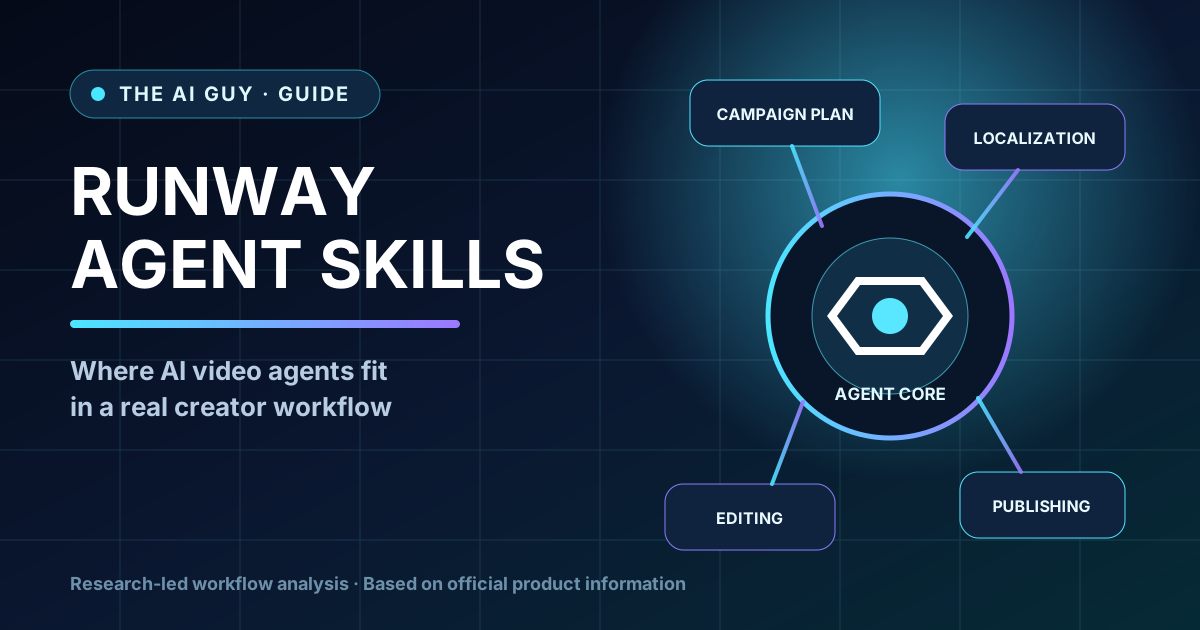
What are Runway Agent Skills, and are they useful for AI video creators?
Runway describes Agent Skills as simple-command workflows for tasks such as building ad campaigns, creating commercials and localizing ads. The practical value is orchestration: connecting a campaign goal to several creative steps. That does not prove the feature replaces dedicated editing, clipping or caption tools, so creators should test one repeatable campaign workflow before changing their stack.
What Runway announced
Runway's official changelog says Agent Skills launched on July 2, 2026, with examples including building an ad campaign, creating a commercial and localizing ads from a simple command. A June 25 Agent 2.0 update also describes campaign creation, creative analysis and scaling across platforms, formats and markets. These are Runway's public product claims as checked on July 22, 2026; The AI Guy has not independently benchmarked Agent Skills.
The useful way to think about Agent Skills
Treat Agent Skills as a possible orchestration layer, not as a magic video button. A campaign may require a brief, several creative variations, aspect-ratio changes, localization, assembly, captions and short-form cuts. The agent may coordinate parts of that chain, while each output still needs a human approval rule and may still need a specialist tool. This distinction matters because automating more steps is useful only when the accepted final output improves or the review burden falls.
Where it fits in the Runway stack
Runway's recent updates show several separate layers. Gemini Omni Flash is listed for generating or editing video from a prompt, image or video. Aleph 2.0 and Edit Studio are described as editing footage from a frame-level direction. Studio can trim, stitch, reorder and export a final video. Agent Skills sit above those production actions by starting from a broader campaign request. That makes the feature most interesting for repeatable creative systems, not isolated one-off generations.
What it does not prove
The changelog does not prove that Agent Skills produce better ads, accurate localization, reliable brand consistency or lower total production cost. It also does not show that creators can remove clipping, captioning or detailed editing tools from their stack. Those are test questions, not launch facts. If a workflow still needs heavy correction after the agent finishes, the automation may move work around rather than remove it.
A practical workflow boundary map
Use five layers when evaluating the feature: campaign orchestration, video generation, edit and assembly, short-form clipping, and captions. Ask which layer is your real bottleneck. If the problem is turning one approved concept into multiple campaign variations, Agent Skills may be relevant. If the problem is finding the best podcast moments or producing accurate subtitles, start with dedicated clipping or caption tools instead. If the problem is frame-level creative control, compare the editing workflow itself rather than the agent label.
The three-question adoption test
First, is the workflow repeatable enough to describe as a clear brief? Second, is coordination the bottleneck, or is the real problem generation quality, editing control, clipping or captions? Third, can someone verify the result quickly using an accepted-output checklist? A good pilot uses one campaign, one audience, one format family, one approval owner and one measurable result. Do not scale until the number of accepted outputs rises or the time spent reviewing them falls.
Who should test it now
The strongest early fit is a creator or marketing team already producing repeated campaign variations across formats or markets. A solo creator making occasional videos may get more value from choosing the right generation, editing, clipping and caption tools separately. Teams handling regulated claims, sensitive brand work or high-stakes localization should keep explicit human approval before publication.
The bottom line
Runway Agent Skills are worth watching because the product direction is moving from individual generations toward connected campaign work. The responsible buying decision is not whether agents sound impressive. It is whether one defined workflow produces more approved creative with less coordination and correction. Test that narrowly, keep the specialist-tool boundaries visible and expand only when the evidence is yours.
Related tools and pages
Official sources
- Runway official changelog ↗Checked 2026-07-22
This is researched analysis based on public product information. The AI Guy has not independently benchmarked the feature described here.
FAQ
What are Runway Agent Skills?
Runway describes Agent Skills as simple-command workflows for broader tasks such as building ad campaigns, creating commercials and localizing ads. The AI Guy has not independently benchmarked the feature.
Do Runway Agent Skills replace video editors?
The public changelog does not prove that. Runway separately lists generation, editing, Studio assembly and agent workflows, so creators should test which steps still require detailed control and human review.
Who should test Runway Agent Skills first?
Teams with a repeatable campaign workflow and many creative variations have the clearest test case. Occasional creators may benefit more from selecting specialist generation, editing, clipping and caption tools first.
How should a team test an AI video agent?
Start with one campaign, one audience, one format family, one approval owner and a measurable accepted output. Expand only if approved output rises or review time falls.
More News & Guides
Google AI Mode Changes SEO: How AI Tool Sites Can Still Get Cited
AI searchGoogle's AI answers reduce traditional clicks, but they also create a new opportunity: become the source the answer engine cites.
Read guide →
How to Build an LLM Council for Better AI Decisions
AI workflowA practical framework for comparing answers from multiple AI perspectives before making a high-stakes business, product, or strategy decision.
Read guide →
Best AI Presentation Maker Questions to Ask Before Choosing a Tool
AI presentationsBefore choosing Gamma, Canva, Tome, Beautiful.ai, or another AI presentation tool, ask these practical selection questions first.
Read guide →