
What is Gemini 3.7 Flash and how much does its API cost?
Google has released Gemini 3.7 Flash for coding and agent workflows. The model is available through Google's developer and enterprise surfaces, and it begins powering Gemini Spark for eligible Pro and Ultra subscribers. Its introductory API rates last only through December 31, so developers should separate today's temporary price from the higher rates Google lists for January 1.
What Google launched
Google introduced Gemini 3.7 Flash on August 13 as a model focused on coding and agents. Axios independently confirms the new Gemini Flash release. Google says developers can use it through the Gemini API in AI Studio, Android Studio and Google Antigravity, while enterprises can access it through Gemini Enterprise products.
The introductory API price has an end date
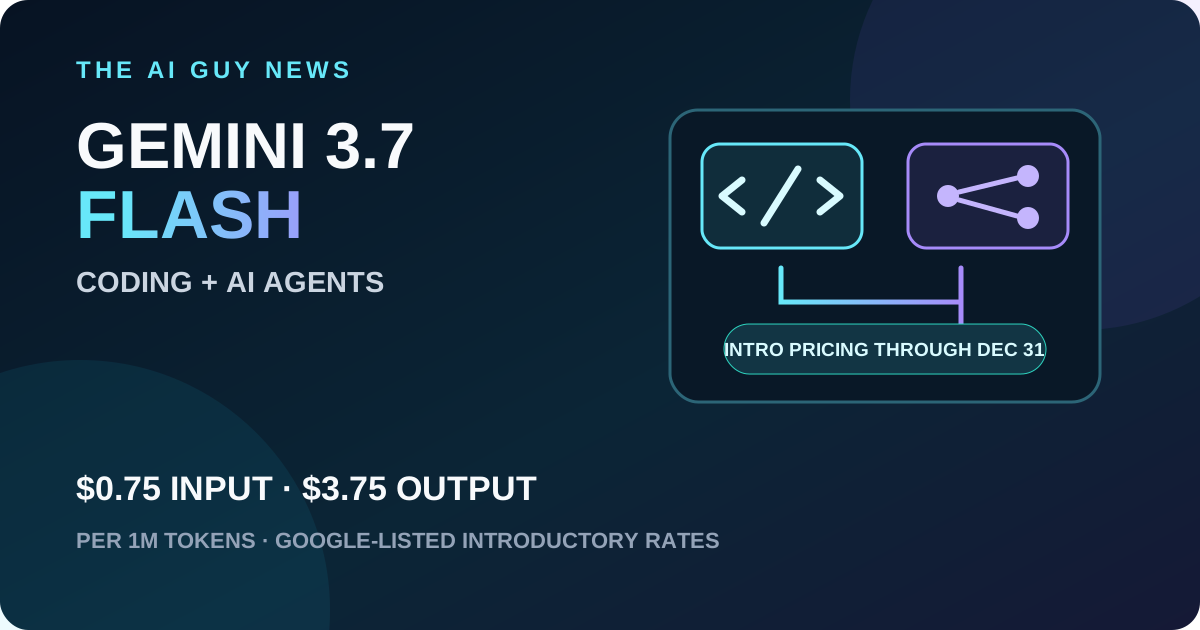
Through December 31, Google lists Gemini 3.7 Flash at $0.75 per million input tokens and $3.75 per million output tokens. Starting January 1, 2027, Google says those rates become $1.50 and $7.50 respectively. These are token rates, not a prediction of total agent cost; tool calls, retries, context size and output length still shape the bill.
Gemini Spark gets the model for eligible subscribers
Google says Gemini Spark begins using 3.7 Flash on August 13 for Google AI Pro and Ultra subscribers in supported countries. The AI Guy has not tested output quality, availability by account or the reliability of long-running actions.
Google reports gains over 3.6 Flash
Google publishes higher results for 3.7 Flash than 3.6 Flash across its cited coding, web-development, document and automation evaluations. Those numbers are vendor benchmarks and should be read as release evidence, not proof that 3.7 Flash leads competing models or will improve every real workflow.
How to evaluate it before changing a workflow
Run one reversible task set that matches the intended use: a bug fix, a small web build and a multi-step tool workflow. Track completed-task quality, retries, latency, input/output tokens and review time. Compare the same harness with the existing model before changing a production default, and calculate costs again using the January rates if the workload will continue into 2027.
The bottom line
Gemini 3.7 Flash is a material release because it combines a coding-and-agent focus, broad Google developer access and a time-limited introductory price. The practical decision is not whether its launch benchmarks look stronger, but whether it completes a representative workflow with acceptable quality and total cost before and after the scheduled price change.
Related tools and pages
Official sources
- Google official Gemini 3.7 Flash announcement ↗Checked 2026-08-13
- Axios independent launch report ↗Checked 2026-08-13
This is researched analysis based on public product information. The AI Guy has not independently benchmarked the feature described here.
FAQ
When was Gemini 3.7 Flash released?
Google announced Gemini 3.7 Flash on August 13, 2026.
How much does Gemini 3.7 Flash cost?
Google lists introductory API rates through December 31 of $0.75 per million input tokens and $3.75 per million output tokens. Google says the listed rates increase to $1.50 input and $7.50 output per million tokens on January 1, 2027.
Did The AI Guy test Gemini 3.7 Flash?
No. This is a researched launch brief based on Google's official announcement and independent launch reporting from Axios.
More News & Guides

Google AI Mode Changes SEO: How AI Tool Sites Can Still Get Cited
AI searchGoogle's AI answers reduce traditional clicks, but they also create a new opportunity: become the source the answer engine cites.
Read guide →
How to Build an LLM Council for Better AI Decisions
AI workflowA practical framework for comparing answers from multiple AI perspectives before making a high-stakes business, product, or strategy decision.
Read guide →
Best AI Presentation Maker Questions to Ask Before Choosing a Tool
AI presentationsBefore choosing Gamma, Canva, Tome, Beautiful.ai, or another AI presentation tool, ask these practical selection questions first.
Read guide →